● Customer Success · v1.5.2
The Customer Success Competency Model
A way to measure a person's performance against their potential in a role — three disciplines, twelve competencies, each described at low, moderate and high complexity, with the interview questions to find them.
Why it matters
Every manager has two stories: the hire who interviewed like a champion and could not do the job, and the quiet one who could have run the place if anyone had noticed. Both are the same failure — measuring the wrong thing. A résumé measures the past. An interview measures charm. What you want to measure is the distance between how a person performs and what they are capable of in this role, at this level of difficulty. That is what a competency model is for, and this one has been doing that job since December 2020.
What’s inside
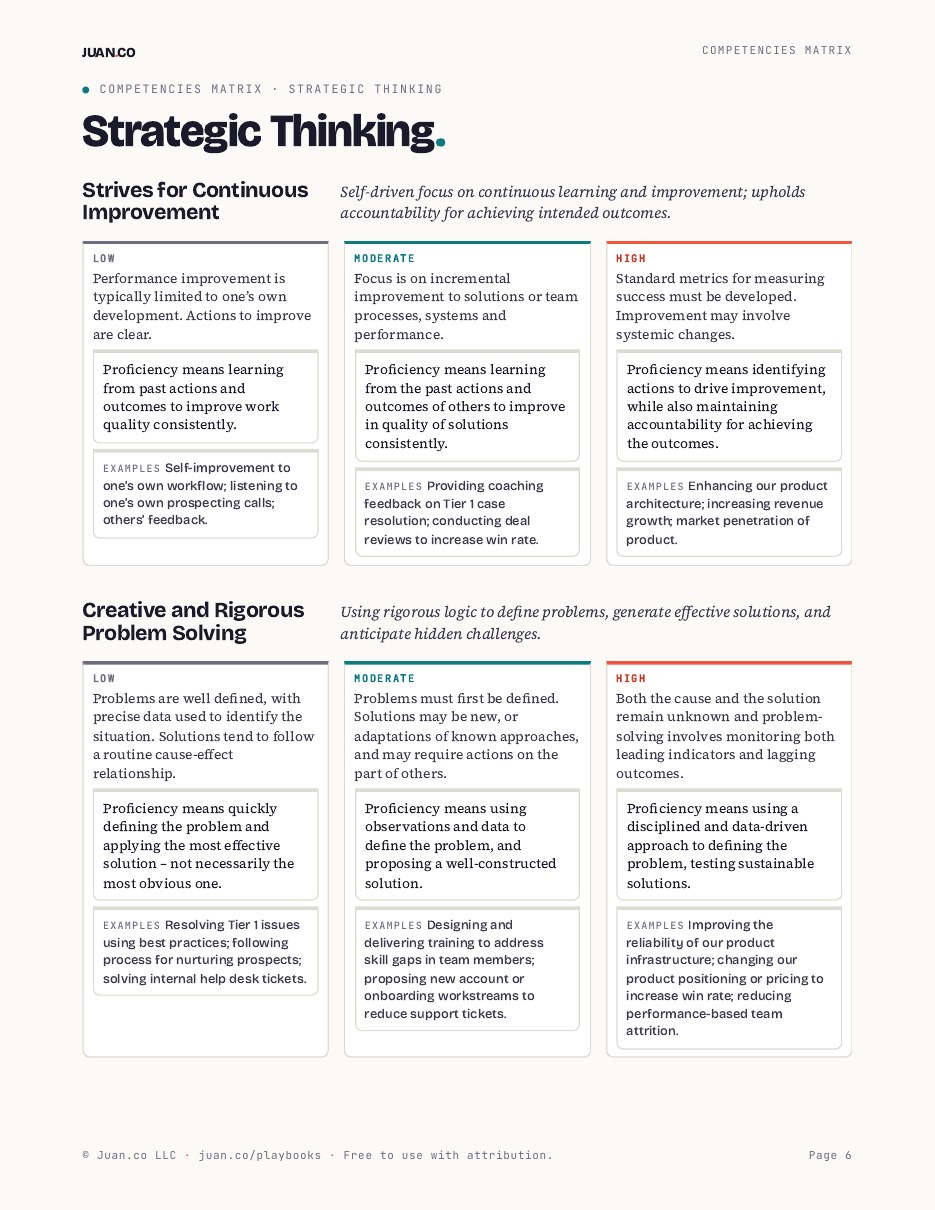
Three disciplines. Everything in the model hangs from three things an executive has to do, whatever the title: exercise disciplined and strategic thinking, demonstrate a bias for action, and build effective relationships. Twelve competencies sit under them, four to a discipline:
- Strategic Thinking — strives for continuous improvement · creative and rigorous problem solving · comfort with complexity and ambiguity · demonstrates good judgment
- Bias for Action — organizes work using processes · manages resources effectively · aligns priorities and efforts to goals · gains consensus on outcomes
- Building Effective Relationships — conveys information clearly · builds authentic relationships · inspires and motivates others · resolves conflict through empathy
Situational complexity. The idea that makes the model work: the same behavior means something different at a different altitude. “Organizes work using processes” at low complexity means following the playbook well; at high complexity it means writing the playbook everyone else follows. Each behavior is described at low, moderate and high complexity, with what proficiency looks like and a concrete example — so a role can be placed, and a person measured against the rung they are on and the one above it. (The matrices, pages 6–11, are domain-agnostic.)
The Customer Success ladder. Customer Success is a moderate-to-high complexity domain, and the model says exactly what each competency looks like for a Customer Success Manager I, a CSM II, a Senior CSM and a Manager of Customer Success — definition and example, every rung (pages 12–24). Two job descriptions close the document as exhibits.
The interview bank. For every competency, the questions that surface it, and the mapping to the Employee Personality Profile — Criteria’s EPP, the assessment many private-equity-backed software companies run before a candidate ever meets a hiring manager — so an interview can probe exactly where the profile says to look (pages 25–37).
How to use it
- Hiring. Place the role on the complexity scale. Pull the questions for the five or six behaviors that matter most at that altitude. Read the EPP, if you have one, for where to press.
- Reviews. Measure the person against their rung’s definition, not against a number. The gap between where they perform and the rung’s definition is the conversation.
- Promotion. The next rung’s definitions are the development plan. Nobody should be surprised by what “senior” means.
If your domain is not Customer Success, keep pages 1–11 and 25–37 as they are and write your own ladder in the middle. The disciplines and behaviors were never about Customer Success; the examples were.
Where it came from
I started building it in 2015. In 2017 it became an internal playbook at Vista Equity, where the EPP was part of how we hired. In 2020 I rebuilt it to lead the Customer Success organizations I founded there and at other private-equity-backed companies — first authorized in this form in December 2020, refined through eleven versions since, most of them in the field. Rebased in 2025–26 as a Juan.co playbook. A decade of use is the only credential it claims.